
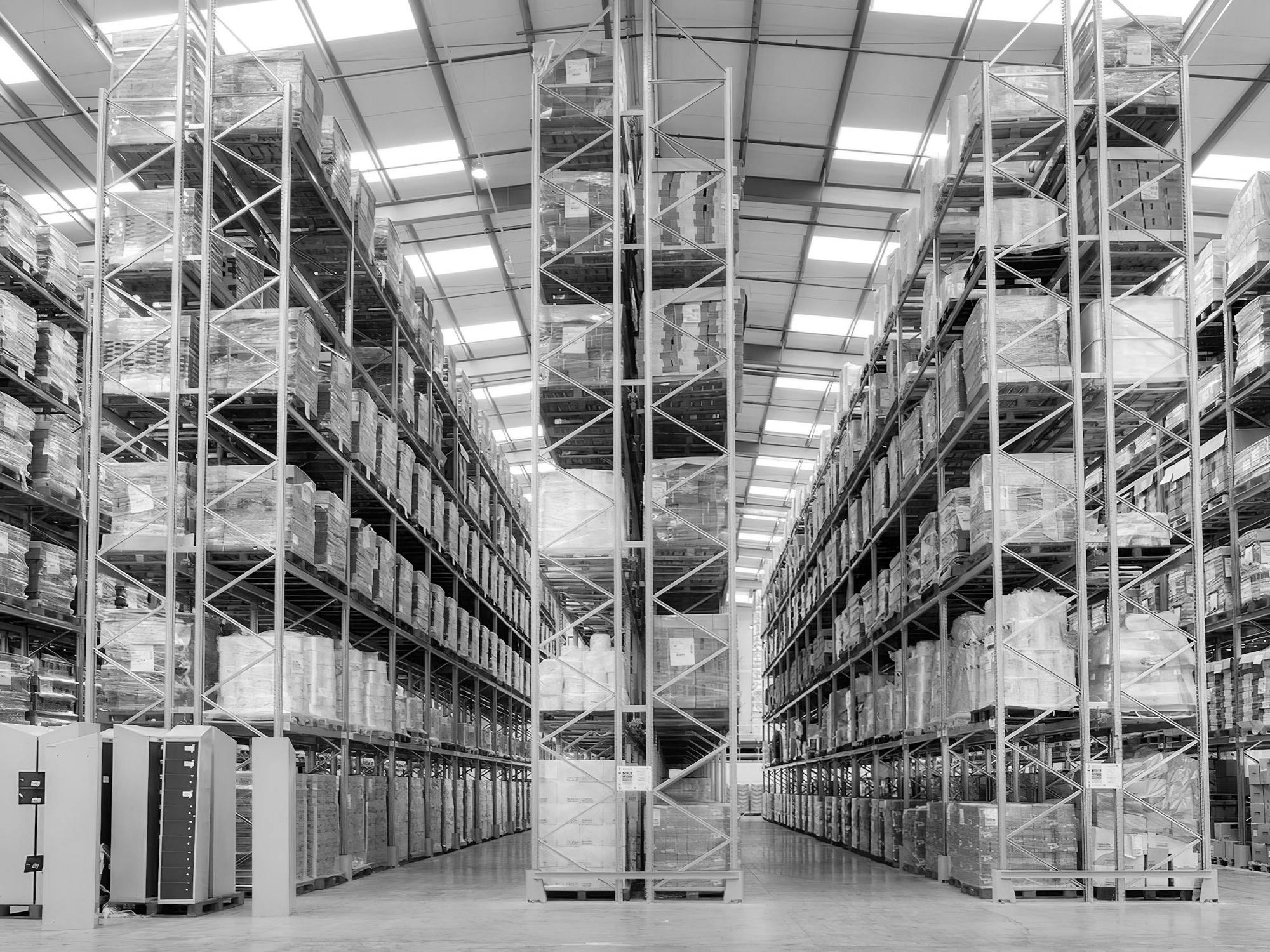
Two 3PL quotes for the same 1,200-pallet requirement can differ by 40% and both be priced honestly. The difference is the billing model, and comparing them requires converting both into one number: fully loaded monthly cost at your actual occupancy curve. Most storage decisions go wrong at exactly that step, because dedicated square footage hides its overhead in space you never put a pallet on.
The two models, stripped to mechanics
Per-pallet billing
You pay for occupied pallet positions, typically month-to-month: $12–25 per pallet per month depending on region and building class, plus in/out handling ($4–8 per pallet each way). Empty positions cost you nothing. The 3PL absorbs the utilization risk and prices it into the rate.
Dedicated square footage
You commit to a block of floor — priced like industrial real estate, quoted in $/sq ft/year (often mirroring local NNN asking rates plus a services layer) — and it is yours whether it is full or empty. Cheaper per position at high occupancy; you carry the utilization risk.
Pallet positions to square feet: the aisle math
A standard 48″ × 40″ GMA pallet occupies 13.3 sq ft of pure footprint. That number is nearly useless on its own, because racking, aisles, and egress decide what you actually rent:
- 1,200 positions in selective rack, 4 beam levels high → 300 floor spots
- 300 spots × 13.3 sq ft = 3,990 sq ft net storage footprint
- Apply a net-to-gross ratio of 50% (aisles, staging, dock apron, egress corridors, office slice) → ~8,000 sq ft of billed space
The net-to-gross ratio is where quotes quietly diverge, and it is driven by the lift equipment the facility runs:
- Sit-down counterbalance: 12–13′ aisles → net-to-gross near 45%
- Reach truck: 8–9′ aisles → around 55%
- Turret / VNA: 5.5–6.5′ aisles → 60%+, but higher handling rates
Two facilities quoting “8,000 sq ft” are not offering the same thing if one racks 4-high with reach trucks and the other floor-stacks 2-high behind a counterbalance fleet. Always ask for positions, not feet.
Regional rate context
Typical asking ranges for Class B warehouse space in the primary hubs (annual, NNN basis — verify current numbers per quote, these move quarterly):
- Inland Empire: $14–19 /sq ft/yr
- N. New Jersey: $15–18
- Chicagoland: $8–10
- Dallas–Fort Worth: $8–9.50
- Atlanta: $7.75–9.25
- Savannah: $7–8.50
The breakeven calculation
Same 1,200-position requirement, Dallas–Fort Worth:
Per-pallet
- 1,200 positions × $16/pallet/month = $19,200/month at full occupancy
- At 70% average occupancy (840 pallets): $13,440/month
Dedicated
- 8,000 sq ft × $9/sq ft/yr = $72,000/yr = $6,000/month for the space
- Add allocated labor, equipment, and management — commonly a 1.6–2.0× multiplier on raw space for a serviced dedicated deal → $10,500–12,000/month
- Cost is flat whether you store 1,200 pallets or 400.
The crossover
At $16/pallet, dedicated at ~$11,000/month beats per-pallet once average occupancy exceeds roughly 690 pallets (58%) — and loses badly below it. A seasonal business that runs 95% occupancy in Q4 and 35% in Q2 usually does best with a smaller dedicated core plus per-pallet overflow, not either model alone.
Audit checklist for any storage quote
- Positions or feet? Get the rack profile, beam levels, and aisle widths in writing.
- Net-to-gross ratio — what fraction of billed space can physically hold product?
- Handling in and out priced separately, per pallet, with reweigh and restack fees listed.
- Minimum billing floors (many per-pallet deals carry a monthly minimum that quietly converts them into dedicated pricing).
- Rate escalators and the notice period on rate changes.
- Insurance basis: warehouse legal liability limit per occurrence vs. your value at risk per location.
Warehouse Atlas returns matched facilities with their own per-pallet rates by region — no markup layered on top. Check the regional estimator, or send your pallet profile and get quotes you can decompose line by line.